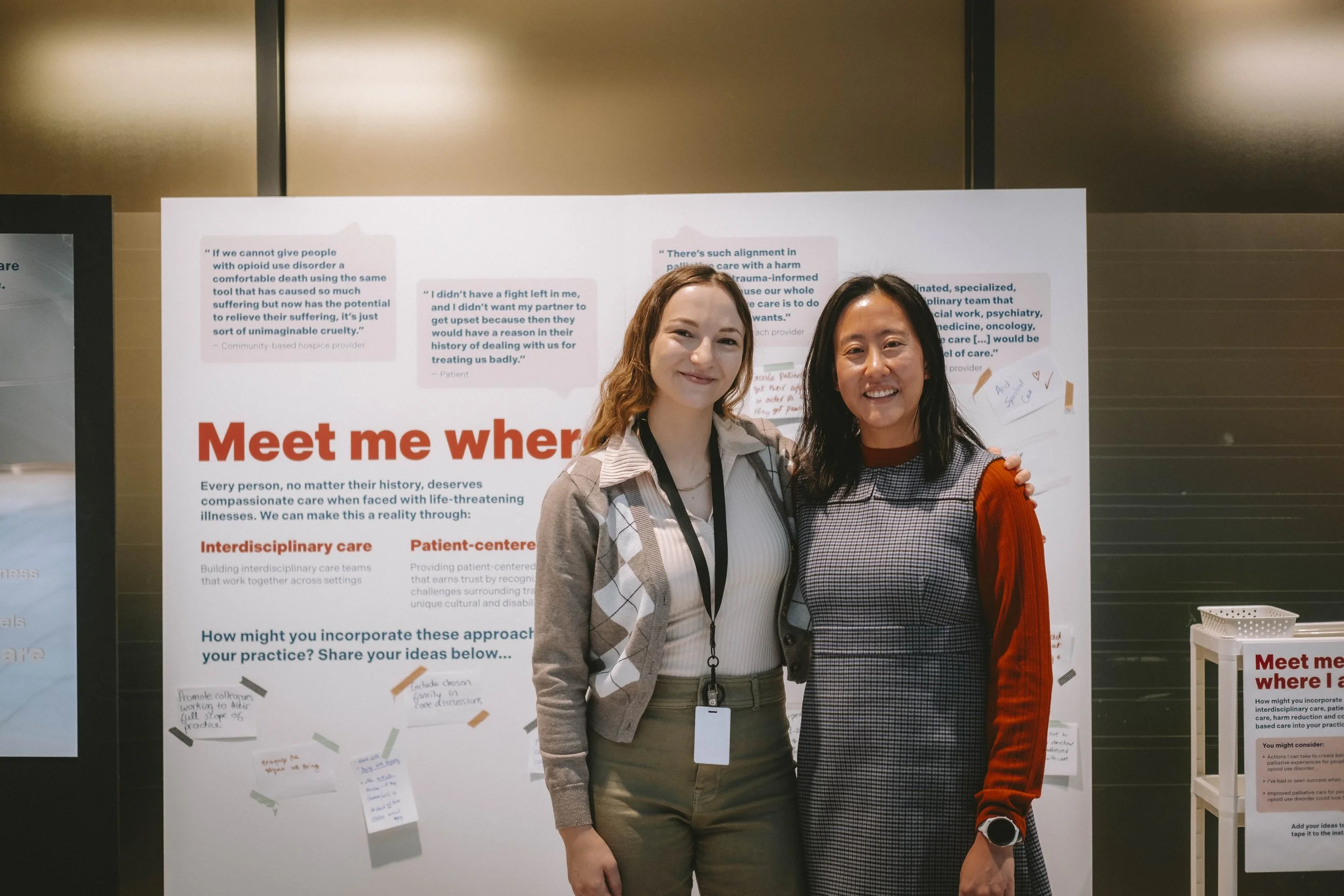
Meet me Where I am
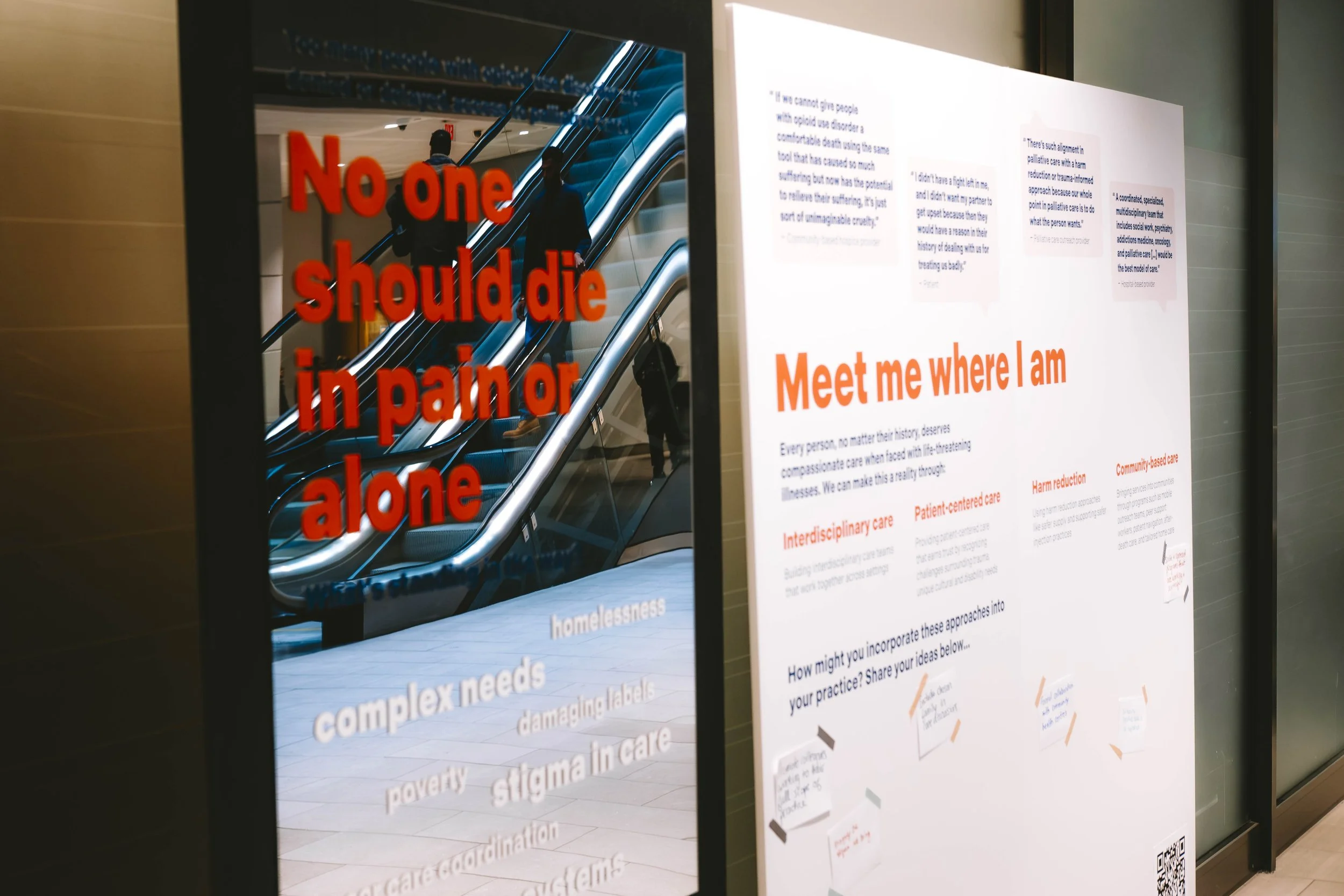
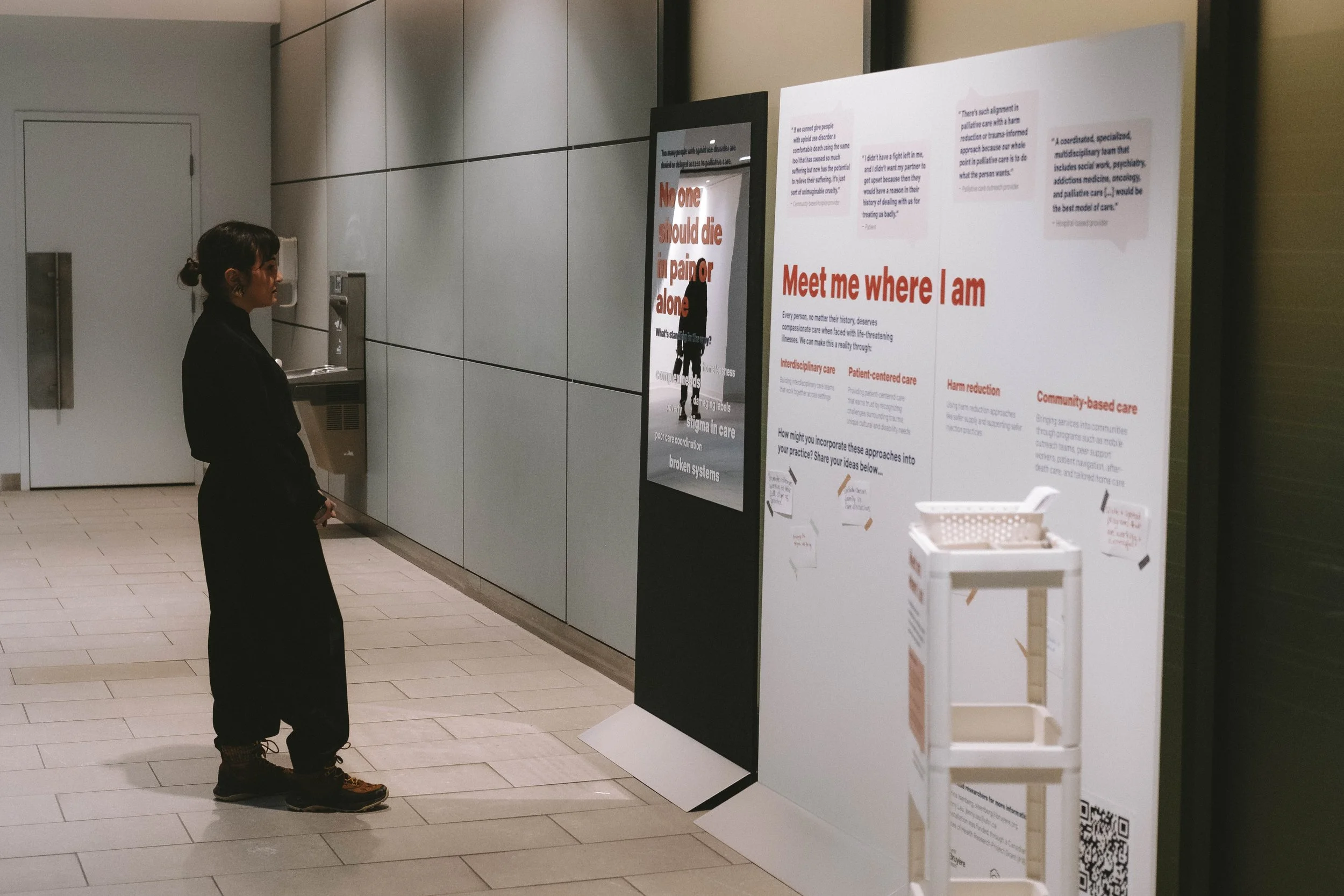
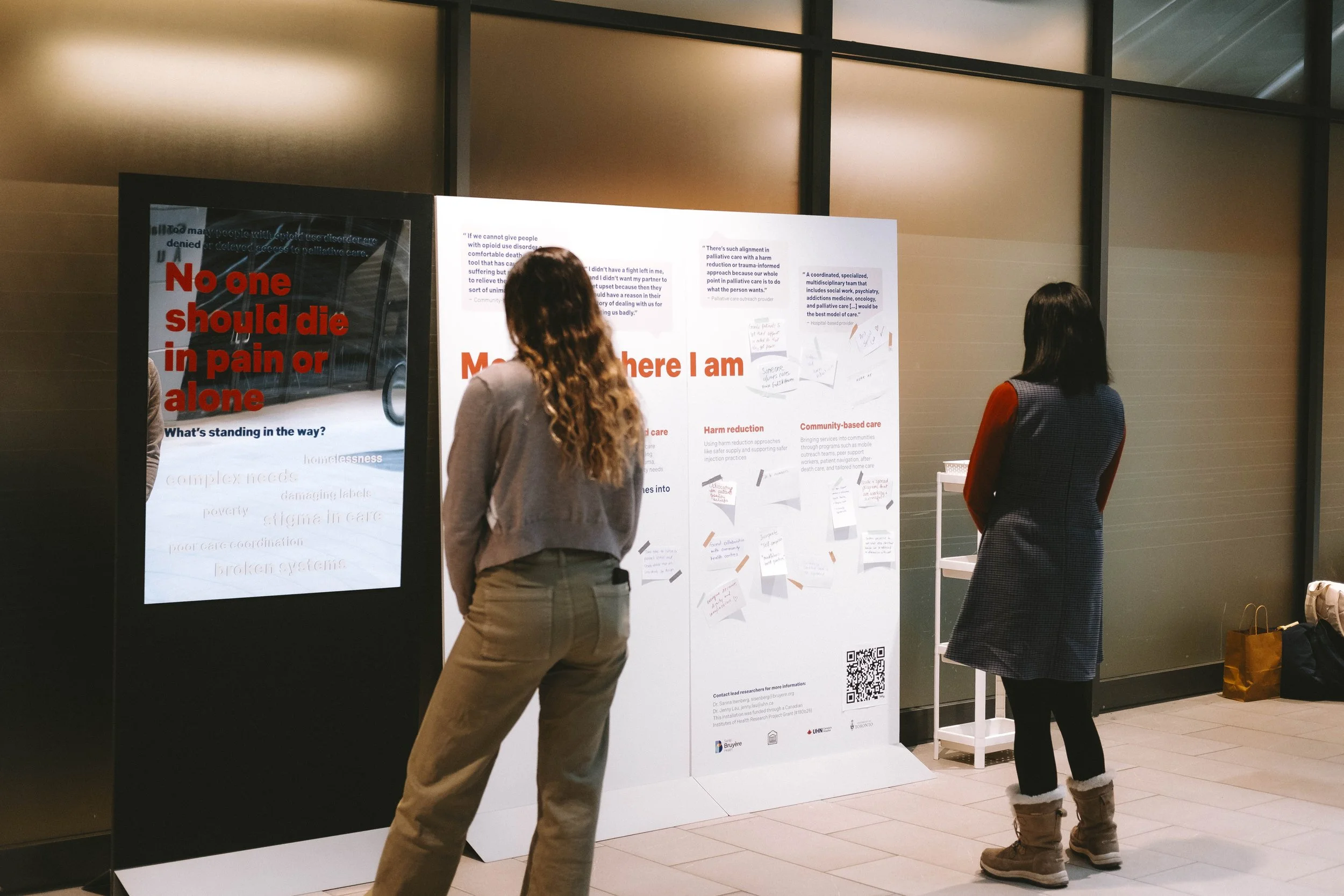
A participatory installation translating research on end-of-life care for people with opioid use disorder into an accessible public experience.
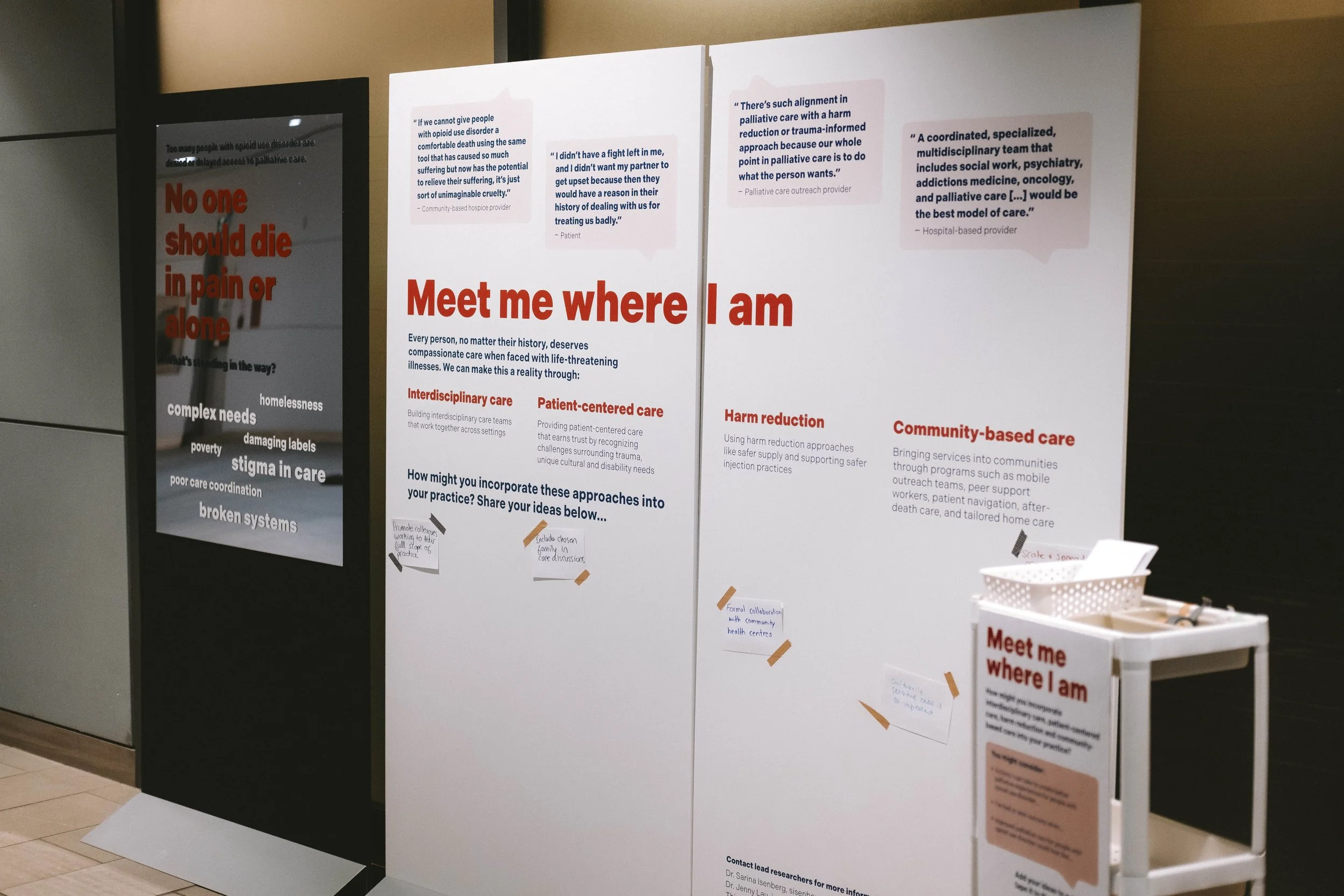
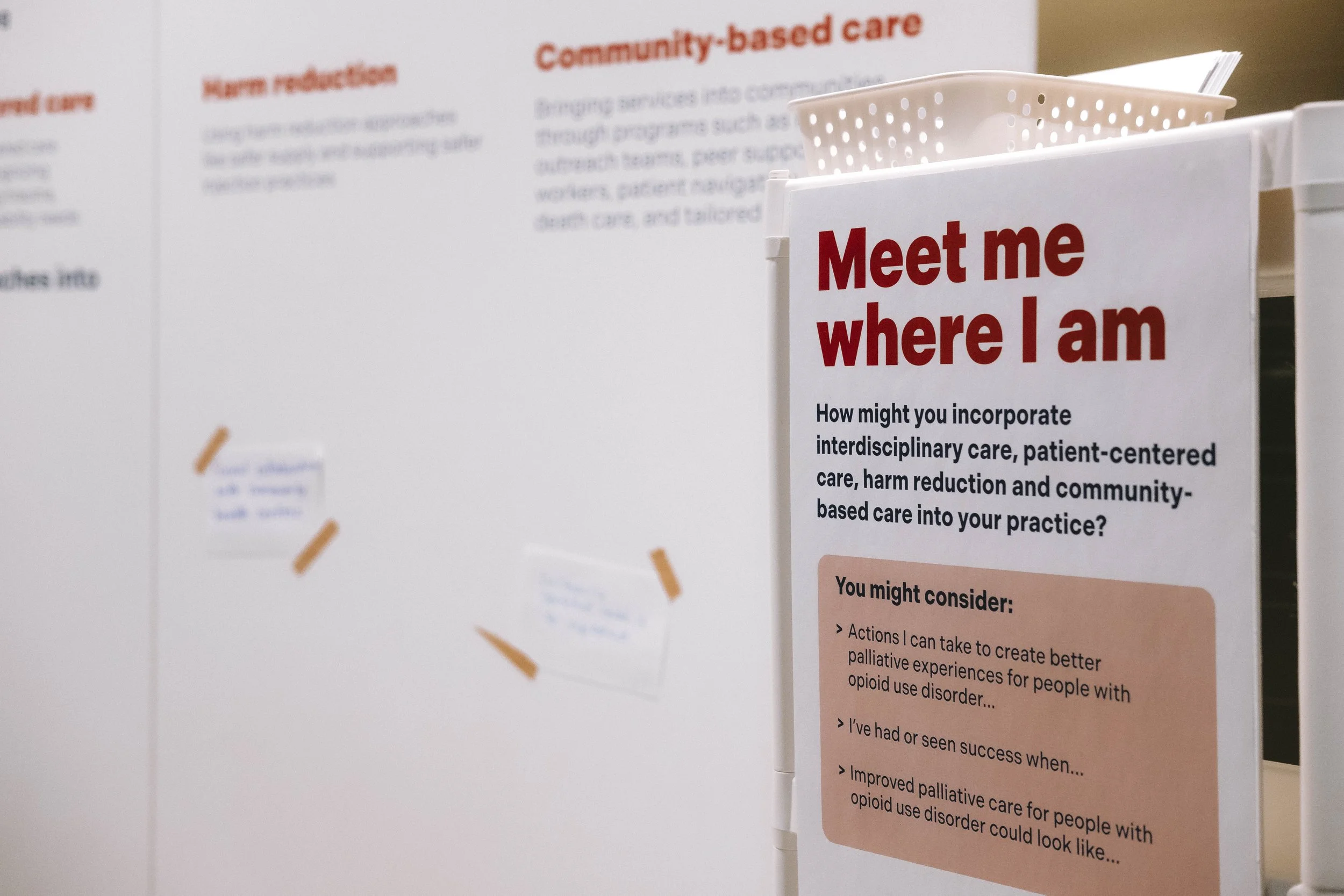
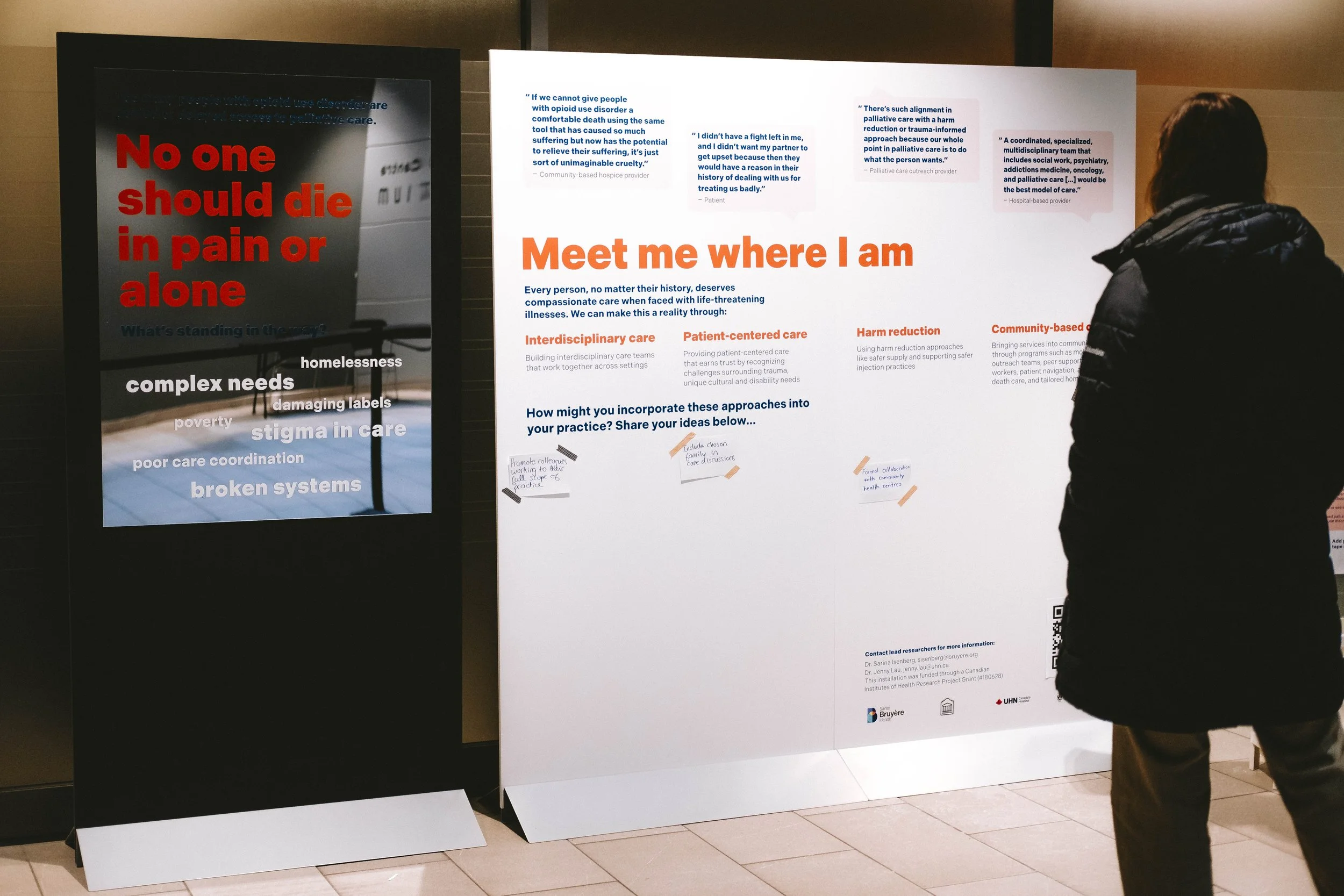
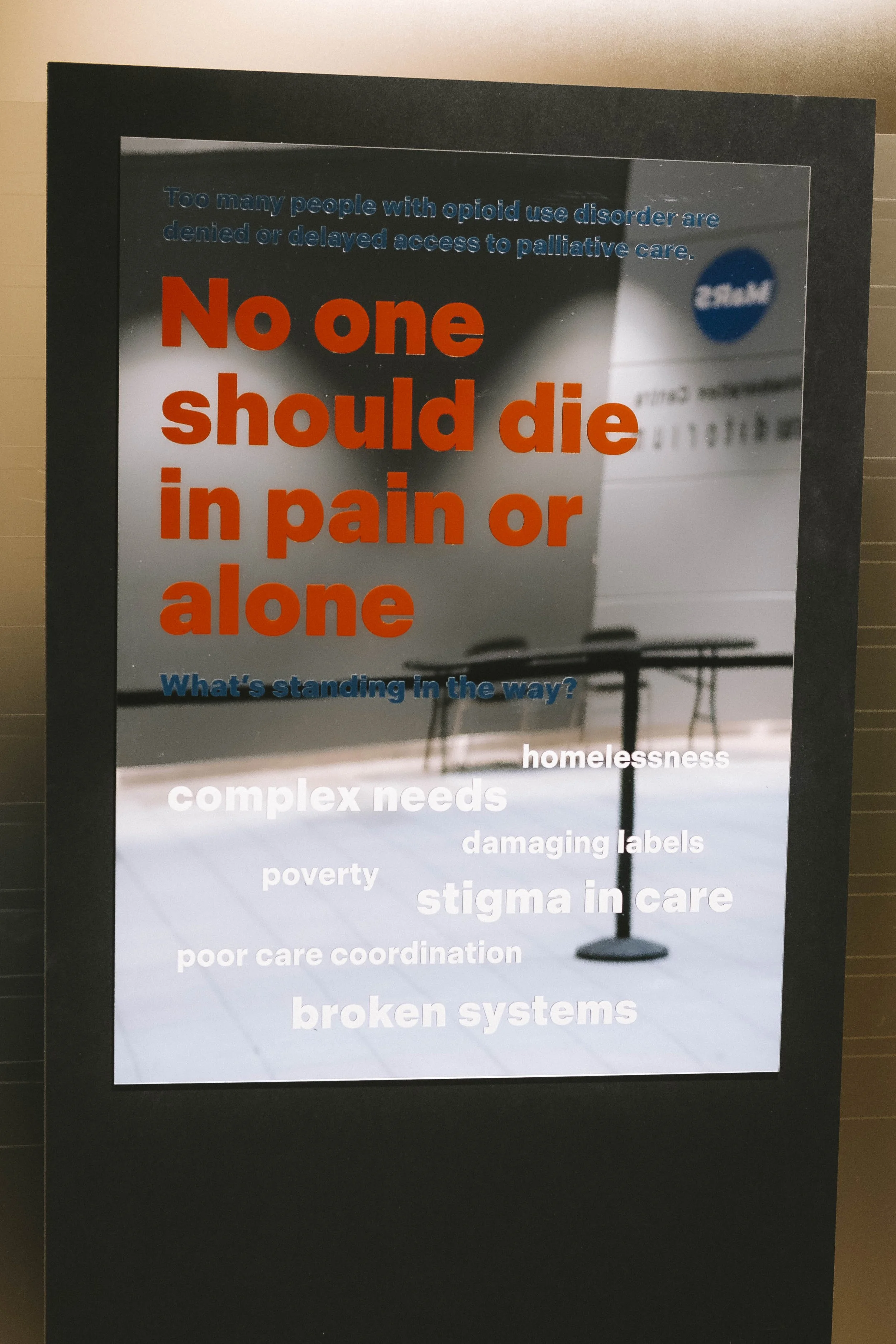
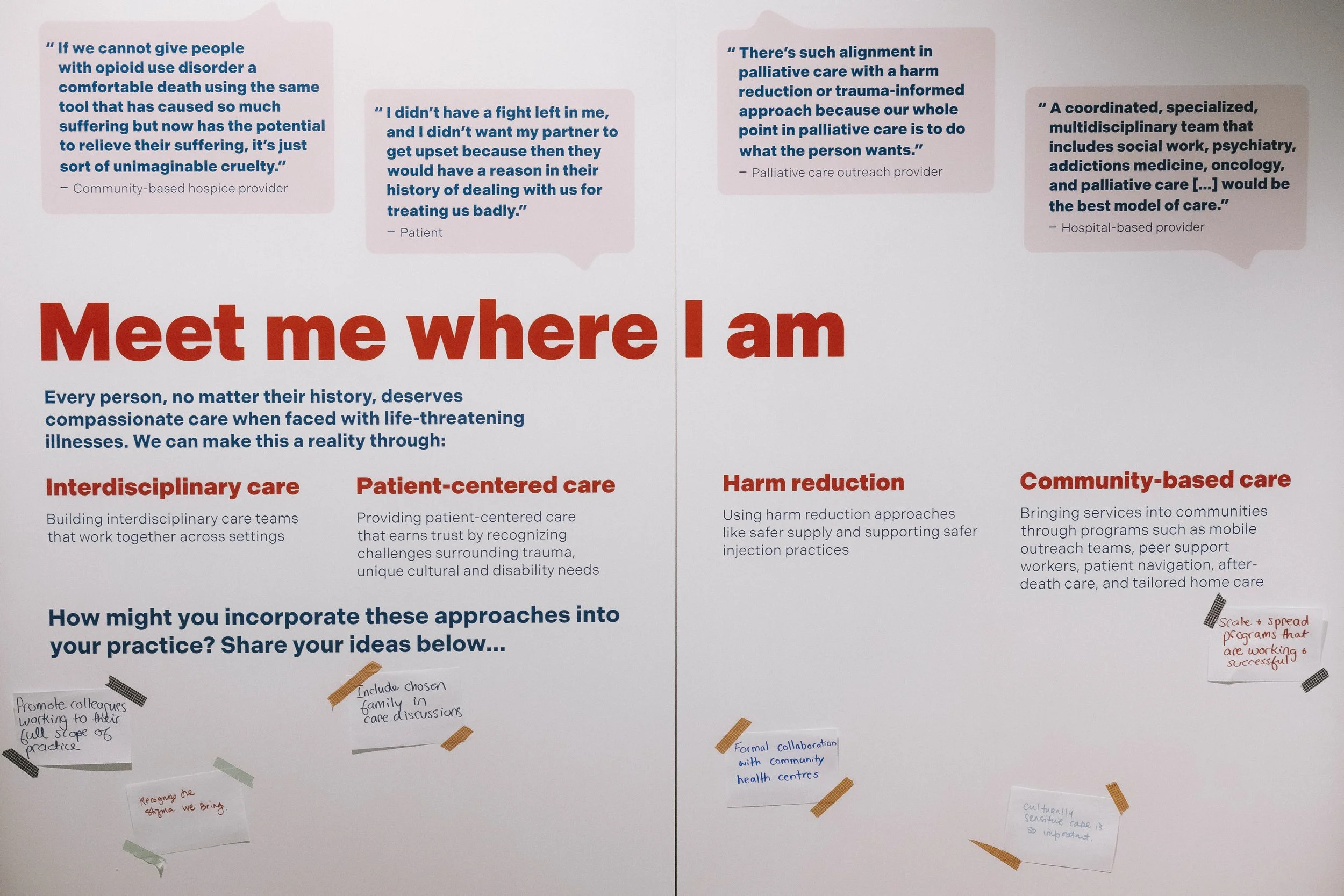
“Meet Me Where I Am” is a participatory, arts-based knowledge mobilization installation created in collaboration with design researcher Karen Oikonen. Drawing on multi-year mixed methods research, the installation translates research findings on the end-of-life and palliative care experiences of people with opioid use disorder into an accessible and reflective public experience.
Quotes from Study Participants
Reflective of the themes represented in the installation.
Barriers
Complex Needs
“Patients with opioid use disorder and serious illness are doubly vulnerable. Anybody who's dying is extremely vulnerable. They're vulnerable to the offer of a bridge to nowhere. They're vulnerable to plans for intervention to fix the problem without consideration for its inevitable failure. They're vulnerable to the cowardice on the part of physicians around the natural and inescapable end-of-life process. And even more so when somebody is facing the end of their life and experiencing opioid use disorder, they're very vulnerable to abandonment to their suffering because of fear around hastening their death, fear of being perceived to hasten their death, fear of losing one's license, fear of disciplinary action. And those fears lead physicians either to not rely on basic logic and transparency around those calculations, but also failure to consider how tragic it would be for someone who's been so grievously abandoned by the health care system and society to die in that same way. If we cannot give people with opioid use disorder a comfortable death using the same tool that has caused so much suffering but now has the potential to relieve their suffering, it's just sort of unimaginable cruelty, in my opinion.”
“I connect. Because doing navigation, I'm the common thread that tries to connect everything together because health care, everybody works in such silos and don't talk to each other. So, my whole role is to try to create some of that continuity and make sure that everybody is on the same page, especially with our folks who have so many complex symptoms. And so much—like, the social determinants of health are complex to navigate. And again, our folks need that completely holistic approach.”
“I think I used the ‘would I be surprised if they died in the next one to two years?’ There’s a lot of 40-year-olds who I would not be surprised if they died for a non-overdose reason. I think of them as dying of old age in their forties, as a consequence of the chronic use and the homelessness and the exposures their bodies have had. Probably see more liver failure and cardiomyopathy than the general population. And so those ones are a bit more predictable.”
Stigma in Care
“I didn't have a fight left in me, and I didn't want my partner to get upset because then they would have a reason in their history of dealing with us for treating us badly, right? If he got aggressive, they would write that he got aggressive or he became rude. He became a threat to other patients' safety. And I've been through that before, and it's like you even raise your voice to match their voice, and all of a sudden, you're violent and aggressive because you're a drug user. So, I calmly just said, “They're not going to help us. We have to go. There's nothing we can do here.””
“If people want something, then I don't understand why we're always having this kind of power dynamic struggle with, well, “I think you should be on morphine.” Well, “I don't like morphine; it doesn't work for me.” Well, “Is it an allergy or a preference?” And it's like, we're not ordering a burger without tomato right now. Like, just give them what they need because it works for them. We talk about patient-centered care, yet so often it seems to be the opposite.”
“They called up my family out in Alberta and told them I was full of track marks everywhere, and I only had one. To this day, I only have one track mark, and it's not long. They told my family I had track marks from head to toe, everywhere.”
Broken Systems
“There is often a lot of siloing, so people have to go here for your food, here for your social assistance, here for your cancer care, here for your palliative care, here for your primary care.”
“The system is not set up to have people who miss appointments, who don’t wait well in waiting rooms, who can't get to places, generally, and then, on time, who need support to get there, who have no phone to book appointments—all of those kind of logistical problems.”
"We also have—our services are set up for families, I find. Like it’s even the language is families. As soon as you have cancer, especially, it’s all about your family and what services are going to involve. And I think that’s really difficult—yeah. Anyway, but so I just think that that alone is a barrier—is to assume that you have someone else to help you make decisions, to go home and talk over decisions. And that’s not necessarily the case.”
"The amount of need versus the amount of service that can be provided here is wildly out of whack. So, the nurses and the providers end up doing a lot of the social service stuff, too, because...that’s who the client is able to open up to.”
"...at my hospital—we do have an addiction medicine team. It's sort of chronically underfunded and understaffed, and so certainly we would love for them to have a greater presence, and we do collaborate when we can, but I think staffing has been a challenge for them."
“There has to be more information out there. There’s not enough communication about palliative care...”
“These folks often don't have a family doctor who can help navigate the rest of their healthcare issues. So, we often end up having to take that on and with the understanding that I'm not a family doctor. I haven't worked in family medicine for my whole career, since I graduated. And so how do we sort of have that risk discussion of what am I not doing for you from a preventative health perspective, but to try to help navigate those key pieces.”
Solutions
Interdisciplinary Teams
“There's no formalized network, although I will say, it is something that we have received a little bit of funding to work on. So, we're trying to develop sort of a harm reduction resource team for the hospital so that there is something that's a little bit more formal where people can turn if they require additional supports beyond just what can be obtained through the addiction medicine service."
“I think it would be helpful to involve a multidisciplinary team. And even though it's a low-frequency population, I think a coordinated, specialized, multidisciplinary team that includes social work, psychiatry, addictions medicine, oncology, and palliative care, that functions in a collaborative care model of care, where there are regular team meetings and there's regular monitoring of outcomes on the patient, would be the best model of care.”
“At the hospital site I'm at, more recently there is a psychiatric team that's geared towards helping folks with addiction, and so making sure that that team can be involved, given their expertise. I'm not an expert on trauma-informed care, so making sure that I have social work and any interprofessional provider that's available that could help. I think a team-based, interdisciplinary and interprofessional approach is the one I would take. It's not always available, which is frustrating.”
“In the end, we connected with this individual's addiction specialist in the community, who really provided us a lot of guidance about how to manage it in hospital. And so, with that support, I personally felt comfortable taking over the prescribing and titration in hospital. And because this patient's specialist was so wonderful, we were able to successfully keep them in hospital through their treatment and then transition them back to her care when they left. So, I would say the key piece there was the collaboration and the incredible support from the community team.”
“Sometimes we will receive calls from opiate agonist therapy clinics saying, "Do you have a space for this person in one of your [housing] units?" So there is, like [physician colleague] was saying before, a growing sense of collaboration among people who care in different realms for people with opioid-related health harms to know each other better and pick up the phone and talk more because we know that those options maybe are not as available with people who don't have that experience caring for those with opioid-related health harms.”
Patient-centered care
“…most of the principles of a trauma-informed approach resonate with me. These are patients traumatized by the health care system… So, there's just a gulf of despair and mistrust that has to be bridged before someone with an opioid use disorder and serious illness can give you a reliable account of their symptoms that you can both believe in. And sometimes for me, that means trusting absolutely what they say, even if I know that their lived experience may be different than their objective account – which means putting them at risk of unwarranted dose increase, because I believe so fully that without that trust there will be no tolerance for the discomfort of attempting to safely manage opioid burden.”
“Number one is to build rapport and gain some trust if possible because a lot of people, especially our population, require more, I guess, patience and time to take care of them because they’ve gone through a lot of different systems that have let them down. And you have to make them comfortable enough for us to care for them. So, at the beginning is always getting to know each other, to build trust."
“… there is specific populations that are more marginalized and harder to access…including racialized communities. […] We have an Indigenous healer that's available, but I think that's a whole other thing that is a struggle of trying to meet, especially this population.”
“I had one patient. He's passed away now, but basically, my secretary knew that she would need to call him an hour before his appointment with me when he came up. Get out of bed. Call yourself a taxi and get to the hospital. You have your appointment with the doctor. And when she did that, he would be here every time. But if we didn't do that, if we just expected him to remember the appointment we gave him a month ago or two weeks ago or one week ago, inevitably he would still be asleep and not come.”
Harm Reduction
“I think and meeting clients where they're at. We’re, I think, especially able to do that with this client that [physician colleagues]'s also talking about. Without that tool [safer supply], I don't know that she would probably be here today because she probably wouldn't have engaged in care, but we also understood that she had opiate use disorder, was obviously suffering from harms related to that. And by us being able to provide her with something that she felt that she wanted and needed, we were able to help her. She's still around today.”
“We can offer using drugs outside, like escorting them to make sure that everything they can do, because harm reduction and palliative care is actually the same philosophy, when you take two seconds and you think about it, it's focused on the client's need. That's it. So, they go really well in hand.”
"The specific forms of opioids that we're able to give people, whether it's opioid safer supply, injectable opioid agonist therapy, the amount of suffering that you can relieve, and the amount of gratitude that you can get from that is very unique. [...] And I would say a unique part of the nurse coordinators that work with us that provide opioid safer supply, is when you start somebody on that type of management or advanced forms of opioid agonist therapy, like injectable opioid agonist therapy, you can get similar reactions in the sense that people—sometimes when they hear that you're going to prescribe opioids for their physical dependence, their opioid use disorder, in a manner that is meeting them where they're at, sometimes people cry. Sometimes people hug you. Sometimes people tell you that you're the best healthcare provider, that it seems too good to be true."
“Even when talking about using a harm reduction approach, I'll say, you can go to this place, and you can smoke, you can drink, you can do whatever you want to do—you do you—and I just try to create that safe environment so that the client can, if they feel that they want to, can be honest and say what they actually are doing with their lives in an attempt to meet them where they're at.”
Community-based Care
“I think having access to teams like the [palliative care outreach] team, the [other palliative care outreach] team in every community, not just the fortunate ones that are like the big centers with one person who really has been influential in getting that up and running and maintaining it and continuing it on, but that it be sort of a universal, something that's available in all communities just because it is—I've just noticed how much value it has for patients in terms of establishing those long-term relationships and that trust. That is so hard to do when you only meet them for a few days or a short time in hospital. And so that team to be able to be there in the community, as well as to provide some support in hospital as well, I think is truly amazing.”
“I think the most important. I said I had these outreach nurses that do mobile outreach street health. [...] And they're the ones that I really felt comfortable talking to about my leg, showing my leg. They taught me how to clean it, how to dress it, how to take care of it. They helped me find other veins to inject in, so I wasn't further damaging that wound. And that was just a game changer for me. I really feel like if I didn't have that care, I would have lost my leg. If I lost my leg, I could have died, right, or I could have died or been permanently disabled in a rehab facility for the rest of my life.”
“The one thing that also is really important that we do in palliative care with our clients that have opioid use disorder or any addiction is actually you take care of all the post mortem that a regular hospice never does. So, we do memorials. We claim bodies so people die with dignity. And we even have access to a cemetery plot if there's no family, because that's a big issue is people were dying and staying in morgues. That's not offered anywhere else, I think, so that's important.”
“We're not promoting enough peers, so when the people that are being paid to do outreach go home at 4:00, there's still people out there. […] We should be supporting those people, those peers. Then we have 24-hour service."
“...lots of housing, especially supportive housing, doesn't allow substance use. So our housing is specialized, in that we expect and rejoice in people who use drugs. […] there's been a long time where there was literally no place for people with health-related harms from opiate use to live where they could get the care they need."
Glossary of Terms Used in the Installation
- Broken Systems
- “Broken systems” refers to fragmented and siloed healthcare and social structures that fail to meet the complex needs of people with opioid use disorder, leading to disparities in access to palliative care at the end-of-life. These system failures manifest as gaps between service sectors, insufficient integration of addiction medicine and palliative care, and structural barriers that contribute to inequitable care and adverse outcomes for people with opioid use disorder.
- Harm Reduction
- Harm reduction is an evidence-based, client-centred approach that aims to reduce the health and social harms associated with addiction and substance use without necessarily requiring abstinence. It emphasizes non-judgmental and non-coercive strategies that provide people who use substances with choice, enhance skills and knowledge, and support safer and healthier lives by focusing on reducing harms rather than eliminating substance use.
- Opioid Agonist Therapy
- Opioid agonist therapy (OAT) are medical treatments for people with opioid use disorder that reduce opioid cravings and prevent severe withdrawal symptoms. It involves the supervised use of long-acting opioid medications that act more slowly and for a longer duration in the body, helping individuals reduce or stop opioid use, lower the risk of overdose, and maintain day-to-day functioning without experiencing intoxication or sedation.
- Palliative Care
- Palliative care is an approach to care that improves the quality of life of patients and their families' facing problems associated with life-threatening illness. It prevents and relieves suffering through the early identification, assessment, and treatment of pain and other physical, psychosocial, and spiritual problems. Delivered through a multidisciplinary, person-centred approach, palliative care supports patients to live as actively as possible and provides caregivers with practical, emotional, and bereavement support.
- Safer Supply
- Safer supply refers to the provision of prescribed medications as safer alternatives to the toxic illegal drug supply for people at high risk of overdose. Delivered under the supervision of a health care practitioner, safer supply aims to prevent overdoses, save lives, and reduce drug-related harms while connecting individuals who use drugs to additional health and social services.
- Trauma
- Trauma is defined as experiences that overwhelm an individual’s capacity to cope. Traumatic experiences can interfere with a person’s sense of safety, self and self-efficacy, as well as the ability to regulate emotions and navigate relationships. Traumatized people commonly feel terror, shame, helplessness and powerlessness. It is very common for people accessing substance use treatment and mental health services to report overwhelming experiences of trauma and violence.
References
- Canadian Mental Health Association (CMHA) Ontario. Harm reduction [Internet]. Toronto (ON): CMHA Ontario; [cited 2026 Jan 5]. Available from: https://ontario.cmha.ca/harm-reduction/
- Health Canada. Treatment for opioid use disorder [Internet]. Ottawa (ON): Government of Canada; [cited 2026 Jan 5]. Available from: https://www.canada.ca/en/health-canada/services/opioids/opioids-use-disorder-treatment.html#a4
- World Health Organization. Palliative care [Internet]. Geneva (CH): World Health Organization; 2020 Aug 5 [cited 2026 Jan 5]. Available from: https://www.who.int/news-room/fact-sheets/detail/palliative-care
- Health Canada. Safer supply [Internet]. Ottawa (ON): Government of Canada; [cited 2026 Jan 5]. Available from: https://www.canada.ca/en/health-canada/services/opioids/responding-canada-opioid-crisis/safer-supply.html
- Canadian Centre on Substance Use and Addiction. Trauma-informed care toolkit [Internet]. Ottawa (ON): CCSA; 2014 [cited 2026 Jan 5]. Available from: https://www.ccsa.ca/sites/default/files/2019-04/CCSA-Trauma-informed-Care-Toolkit-2014-en.pdf
Exhibition Gallery